


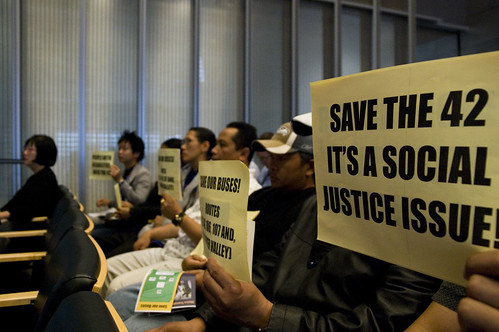
In a special public hearing at City Hall, the City Council’s transportation subcommittee met on Wednesday to discuss the 2010-2011 King County Metro budget, and the plan for overcoming a $700 million revenue shortfall.
In front of a chamber full of transit riders, drivers and concerned citizens, King County Executive Kurt Triplett and King County Metro General Manger Kevin Desmond presented their proposal: a four-year plan to offset the projected $546 million deficit including service cuts, fare increases, and improvement program deferrals. Despite an increase in ridership for the last three years, Desmond stressed the significance of 12-13% drop in sales tax collection which is a main revenue source for Metro.
Alongside Desmond and Triplett were two other panelists: Rob Johnson and John Scholes of Transportation choices and the Downtown Seattle Association respectively. Johnson informed the public in attendance that transit cuts were not a King County exclusive issue, citing that 90% of public transit systems nation wide have raised fares and/or cut service hours. Scholes, representing downtown businesses and citizens, applauded the ride free area, but wanted the idea of a new revenue source for Metro outside of sales tax to be on the table. “We need another source that is stable in good times and stable in bad times,” he said.
Representatives from South Seattle and the Rainier Valley area dominated the public comment portion of the haring. Concerned about service cuts to routes 42, 48, 106, and 107, sign-holding audience members and a parade of citizens came up to the microphone protesting bus stop removal and frequency reductions. Citizens called those routes their “lifeline,” and added that the cuts have a disproportional effect on people with low income and people of color.
Other concerns from public comment:
- Labor costs
- Connections between ferries and buses.
- Against scheduled maintenance cuts, stressing the quality of service rather than the span.
- Moving away from the politics of universal service cuts and run Metro like a business. Executive Triplett responded, saying it would have been more difficult to go route by route, and that Metro wanted to “balance the needs of the transit dependent as well as the people just getting to work every day.”
While the $20 vehicle license fee suggested by Washington State Legislature was vetoed by the governor, Desmond provided two other options to aid the falling revenue: $50 million in already allocated stimulus money, and reappropriating property taxes. However, he said that the ferries will continue to be maintained and expanded for the next four years under this proposal.
As expected, cuts to the Metro system were the focus of the proposal. These cuts include:
- Deferring bus expansion: While the new RapidRide(link) services will continue full force, taking 4.5 cents of the total 5.5 cents from property taxes, Transit Now service investments are being deferred as well as investments in scheduled maintenance. Desmond noted that this does not mean Metro is favoring the specific RapidRide routes while cutting overall service.
- Capital program cuts: Metro will greatly reduce the number of buses it purchases, and speed, reliability and asset maintenance programs will be cut.
- Non-service related cuts: 10% reduction in complementary programs like security enhancements, customer information and park and ride landscaping and cleaning.
- Operating reserves: The proposal is reducing its reserve fund, which it uses in case of an emergency, as well as its fleet replacement reserve. The latter will go into funding and maintaining the current buses.
- Fare Increase: The proposal includes the already approved $.25 fare increase in January 2010, but calls for another $.25 increase in 2011. This would move the base fare rate to $2.25. Desmond added that the projected 1% ridership decrease with fair increases was already factored into the budget deficit.
- Bus Service Suspensions: 310,000 hours cut by 2011, with a possible total of 585,000 by 2013. This amounts to a 9% cut in service that will be spread out over all service lines. The first 50k in 2010 will be administrative, and will bypass the normal service change process that will be applied to the rest of the cuts. Desmond stressed that no routes will be removed, but cuts will be administered through reduced frequency, reduction or elimination of weekend routes, and earlier final stop times; all of which depend on the size and popularity of the route. “If you see a line on a Metro map today, that line will stay there,” said Desmond.


The State of Washington report that the sales Tax Drop was on seven percent in Seattle. I think the county is really off base.
If you think service is bad now what untill they try to cut more routes.
Metro could offer retirement packages to workers who are close to retirement. I hear alot of Metro workers are close to retiement now.
I also am wondering why King County is not asking for Government assistance. They are helping GM why not us
Send your comments to: [email protected]
Balanced budget without cutting service
Transit budget gap
-$98
Efficiencies, increased entrepreneurial activity, and non-service operating cuts
$22
Repurposing of ferry district property tax levy
$15
Transit Now—live within the means
$11
Use of excess fund balance found through transit audit
$50
With families struggling to make ends meet during this economic downturn, we cannot afford to lose the transit service we rely on to save money while getting to work and job interviews. And our struggling small businesses need transit as a dependable way to get employees and customers to their stores. That’s why my plan “Keep Metro Moving” calls for balancing the budget without cutting service or raising taxes while the economy is recovering in 2010.
Facing a budget shortfall of $98 million next year and $200 million over the next biennium, Metro has been contemplating drastic service cuts of up to 20%. Such cuts will cause up to 78% of Metro’s routes to be decreased or eliminated, increasing congestion, impacting nearly every bus rider, and destroying a decade of growth in our transit system. That’s unacceptable. Transit service cuts of any magnitude must be a last resort, so “Keep Metro Moving” calls for Metro to balance the budget through a combination of non-service related cuts and a portion of excess fleet replacement funds.
First, while most general fund-supported county agencies are sustaining cuts of 8-10% next year, I will ask Metro to cut their annual operating budget by up to 4% in 2010, resulting in a savings of at least $22 million. Metro can make these cuts without reducing bus service hours by:
•Implementing efficiencies that will be identified in the transit audit I sponsored last year, with final results due in September.
•Offsetting costs by increasing entrepreneurial activities like advertising and sponsorships, per legislation I introduced earlier this year (Proposed Motion 2009-0345).
•Reducing higher than average operating costs.
•Cutting non-service related costs.
Second, I am proposing to repeal the entire King County Ferry District property tax levy in 2010 and use the freed up tax capacity for bus transit service instead. While I have been a long time supporter of waterborne transit, the current economic turmoil requires that we protect and prioritize basic services above extras.
Third, I will ask Metro to live within our means with the Transit Now service expansion—that means, with sales tax receipts coming in lower than projected, only the revenues raised by the Transit Now .1% sales tax will be spent on Transit Now service increases. That will delay some of the Transit Now proposed improvements, but reduce Metro’s deficit by $11 million in 2010.
To make up the remaining projected $50 million shortfall in 2010, “Keep Metro Moving” uses a portion of the $105 million excess fleet replacement fund balance identified by the transit audit I sponsored. That leaves $55 million available for future needs.
Metro’s future, secured
Today we are talking about avoiding cuts, but with buses overcrowded and transit ridership up 23 percent over the last four years, the conversation of the not-too-distant future must be about increasing service in a significant way. “Keep Metro Moving” uses a combination of making efficiencies and prioritizing to survive 2010 without transit service cuts, but to secure Metro’s future beyond 2010 we must engage in a regional dialogue about avoiding future service cuts, increasing service to meet the growing demand, and reforming Metro’s service allocation policies to reflect the transit needs of our county. From rapidly growing, underserved suburban communities like Sammamish, to transit-reliant areas in South King County, and transit-loving Seattle, all parts of King County need more bus service, not less. It’s imperative for our economy, environment, and quality of life that we increase transit options. As the economy recovers, I will work with state leaders and citizens to give voters a proposal for increasing bus service to meet the rising demand.
And as this recession has taught us, Metro’s overreliance on the volatile sales tax as a revenue source leaves us vulnerable to transit cuts during economic downturns. I will ask the legislature to provide Metro with funding alternatives besides the sales tax to bring stability to Metro’s budget. I will also create a rainy day fund in addition to Metro’s current 30-day operating reserve so the agency has a buffer against service cuts the next time the economy takes a dive or fuel costs spike.
Improved service, improved productivity
One lesson this recession has taught us is that governments must strive to get the most value out of every dollar they collect. So though I will not support a reduction in overall transit service, I will challenge Metro to use existing service hours better. Throughout King County, Metro should engage communities and, where it makes sense, look at cutting, consolidating, or restructuring duplicative or underperforming routes in order to increase service on more productive routes in the same corridors or centers. In other words, do fewer routes better. Use existing resources to boost ridership, improve service quality, and increase productivity.
21st century transit system
Tens of thousands of Metro Transit riders everyday simply want to know when their bus will arrive, rain or shine, sporting event or windstorm. I will support projects already budgeted and underway that will put GPS on every bus and improve Metro’s radio system to allow better tracking of buses on the road. Further, I will ask Metro to work with innovators like University of Washington and grad student Brian Ferris, creator of the Metro bus tracking website One Bus Away, to improve real time trip planning, even as buses are rerouted for snow and accidents. In any weather or circumstance, bus riders will have everything they need to reach their destination in the palm of their hand through their cell phone.
http://kingcountymetrosucks.blogspot.com/2008/05/coming-soon
News organizations got a judge to release them, and they showed that before she was fired, Hutchison called in sick to take a weekend vacation in Oregon and accused the station’s male general manager and its news director, a lesbian, of having an affair. She also took a stress-related medical leave after being told her duties at the station were being reduced.
Phillips praised the release of the documents for giving voters a better idea of who Hutchinson is.
It sounds like that King County is creating a Budget Short fall to screw union workers on their next contract negotiations.
http://www.kingcounty.gov/transportation/kcdot/NewsCenter/Ne
/2010/August/nr082710_trolley.aspx
Come to a public meeting
Mt. Baker Community Club
7 p.m. on Mon, Sept. 13
2811 Mt. Rainier Drive S
Seattle Electric Vehicle Association
7 p.m. on Tue, Sept. 14
4401 2nd Ave NE
For more information contact:
Ashley DeForest
Community Relations Planner
Communications
King County Department of Transportation
[email protected]
206.684.1154
Please do not cut the 17th and NW Market Street bus stop for Route 44.